
How Long Does It Take to Go from JLPT N5 to N4?
TLDR
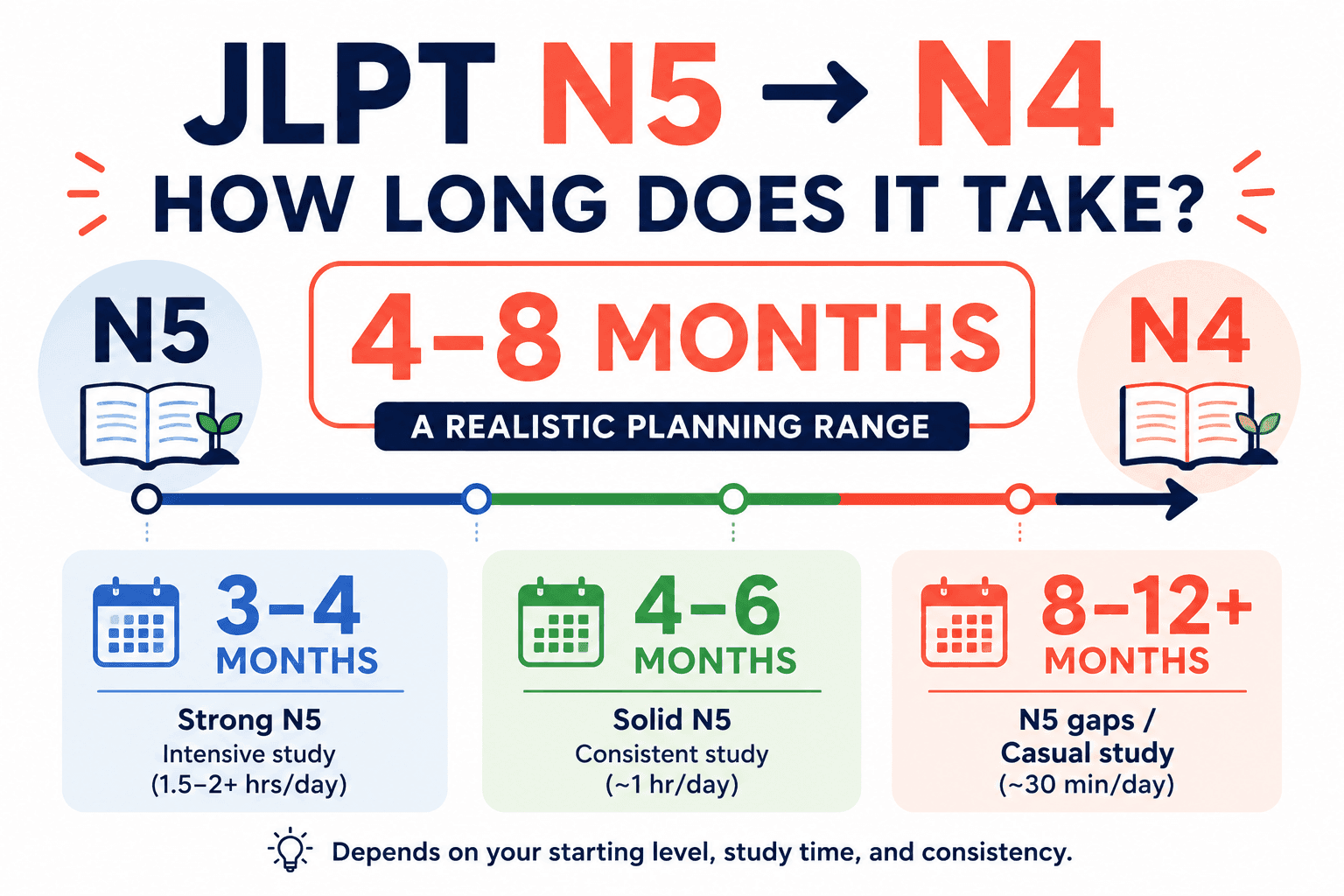
For someone who already has a genuine JLPT N5 foundation, around 4–8 months is a reasonable planning range for reaching N4 with consistent study.
A strong N5 learner studying intensively may be ready in around 3–4 months.
Someone who has just passed N5 but still has gaps may need 6–9 months, while lighter or inconsistent study can easily stretch the transition beyond a year.
But there is a more important point:
Passing N5 tells you where you finished an exam. It does not tell you exactly where you are starting N4.
Two learners can both have an N5 certificate and need completely different amounts of time to reach N4.
Quick Answer
Going from JLPT N5 to N4 commonly takes around 4–8 months with consistent study, but there is no official JLPT study-hour requirement.
A useful planning guide is:
Starting point | Study intensity | Practical timeline |
|---|---|---|
Strong N5 | 1.5–2 hours/day | 3–4 months |
Solid N5 | Around 1 hour/day | 4–6 months |
N5 with gaps | Around 1 hour/day | 6–9 months |
Casual study | Around 30 minutes/day | 8–12+ months |
These are planning estimates, not guarantees.
The biggest factor is not simply how many months you study.
It is:
How automatic is your N5 Japanese already?
How Long Does N5 to N4 Actually Take?
There is no single correct answer.
You will find study plans online promising:
N4 in 90 days
N4 in four months
N4 in six months
N4 in a year
None of those timelines is automatically wrong.
The problem is that they often ignore the most important variable:
your starting point.
If you passed N5 yesterday with a very strong score and N5 material already feels easy, you are not starting from the same place as someone who narrowly passed N5 a year ago and has forgotten much of what they studied.
That is why a range is more useful than one magic number.
A practical planning guide is:
Strong N5 + Intensive Study
Around 3–4 months
This may be realistic if:
N5 vocabulary feels automatic
basic grammar is comfortable
kana reading is fast
you already know more than the minimum N5 kanji
N5 listening feels relatively easy
you can study consistently for 1.5–2 hours or more most days
Solid N5 + Consistent Study
Around 4–6 months
This is probably the most sensible target for many learners.
You have a reasonably strong foundation but still need time to:
expand vocabulary
learn more kanji
build N4 grammar
increase reading volume
improve listening
become familiar with N4-style questions
N5 With Gaps
Around 6–9 months
You may need longer if you technically passed N5 but still struggle with:
particles
conjugations
basic vocabulary
slow kana reading
common kanji
N5 listening
Some of your “N4 study” will actually be spent repairing N5.
Casual Study
Around 8–12 months or longer
If you study for 20–30 minutes most days, progress can still be very good.
It will simply take longer to accumulate enough exposure and practice.
That is completely fine.
The goal is sustainable progress, not winning a race against someone else’s study schedule.
The Biggest Factor: How Strong Is Your N5?
Imagine two learners.
Both have passed N5.
Learner A
They passed narrowly.
They still:
pause when changing verbs into past tense
confuse に and で
read hiragana slowly
forget common N5 vocabulary
struggle with listening unless every word is familiar
Learner B
They also passed N5.
But they:
recognise N5 vocabulary quickly
handle basic verb forms automatically
read simple passages smoothly
understand common particles
follow slow everyday listening comfortably
On paper:
both are N5.
In practice:
Learner B is much closer to N4.
This is why I would not start your N4 plan by asking:
When did I pass N5?
Ask instead:
What parts of N5 still slow me down?
That answer will tell you far more about your timeline.
What Changes from N5 to N4?
The official JLPT descriptions give us a useful distinction.
N5 measures the ability to understand some basic Japanese.
At N4, the expectation becomes the ability to understand basic Japanese.
That sounds like a small wording change.
In practice, it represents an important step.
A simple way to think about it is:
N5 = understand basic pieces
N4 = connect those pieces
At N5, you may understand:
a familiar sentence
a basic expression
a short exchange
isolated vocabulary
simple instructions
At N4, those pieces increasingly need to work together across:
passages
everyday situations
connected grammar
longer conversations
You are still learning basic Japanese.
But the Japanese is becoming less isolated.
How Much Vocabulary Do You Need?
A practical planning estimate is:
N5: around 700–800 cumulative words
N4: around 1,500 cumulative words
So going from N5 to N4 may mean adding roughly:
700–800 more words
These numbers are not official requirements.
The modern JLPT does not publish a fixed vocabulary list that says:
Learn exactly these 1,500 words and you have completed N4.
Use the numbers as planning guides instead.
And remember:
learning 700 flashcards is not the same as gaining 700 usable words.
You need to recognise those words inside:
sentences
reading passages
listening
grammar questions
That takes repeated exposure.
How Much Kanji Do You Need?
A common practical estimate is:
N5: around 100 kanji
N4: around 300 kanji
So the transition may add roughly:
200 kanji
Again, these are study estimates rather than official JLPT requirements.
But kanji learning also changes as you progress.
At first, learners often think:
I know this kanji.
because they recognise its basic meaning.
For example:
学
study
But what matters more is recognising kanji inside words:
学校
school
学生
student
大学
university
N4 reading becomes easier when you recognise the word, rather than stopping to decode each individual kanji.
What Changes in Grammar?
N5 gives you the foundations:
basic particles
simple verb forms
adjective forms
past and negative sentences
requests
preferences
basic comparisons
simple reasons and connections
N4 expands the number of ways you can express:
experience
intention
obligation
possibility
sequence
reasons
conditions
changes
plans
giving and receiving
But there is another important change.
At N5, you may study grammar like this:
grammar point → example sentence
At N4, several familiar grammar patterns increasingly appear together.
You need to process:
the whole sentence
rather than identify one isolated rule.
That is why mastering your N5 basics matters so much.
If every particle and conjugation still requires conscious thought, longer N4 sentences become exhausting.
What Changes in Reading?
N5 reading often involves:
short sentences
simple notices
familiar expressions
basic everyday situations
At N4, you need to follow passages about familiar daily topics.
That means you begin dealing with more:
connected sentences
context
descriptions
everyday messages
simple explanations
The challenge is not just knowing more vocabulary.
It is maintaining meaning across several sentences.
Imagine reading:
Sentence 1
→ stop and translate
Sentence 2
→ stop and translate
Sentence 3
→ forget Sentence 1
You may understand every sentence individually and still fail to understand the passage.
So one of the most important N5 → N4 skills is:
reading flow.
What Changes in Listening?
N5 listening focuses on short conversations about familiar situations, usually spoken slowly.
N4 still uses relatively slow everyday Japanese, but you are expected to generally follow the content of daily-life conversations.
That means listening becomes less about catching:
one familiar word
and more about understanding:
what is happening.
For example:
Who is speaking?
What do they need?
Where are they going?
What did they decide?
Why did the plan change?
This is why listening should not be something you “add later” once you have finished your vocabulary list.
Start it early.
How Many Study Hours Does N5 to N4 Take?
There is no official JLPT answer.
The JLPT does not say:
N4 requires exactly X study hours.
You will find many estimates online.
They vary because learners differ enormously in:
previous Japanese study
kanji knowledge
native language
study quality
consistency
reading exposure
listening exposure
how strong their N5 foundation is
Study hours are therefore better used as:
a planning tool
rather than:
a prediction formula.
For example, someone studying seven focused hours every week for six months will accumulate roughly 180 hours of study.
But even that number does not tell us:
what they actually did during those 180 hours.
Seven hours of focused reading, listening, vocabulary retrieval, and grammar practice is different from seven hours spent passively watching lesson videos.
So instead of obsessing over the exact number of hours, ask:
What abilities are improving because of those hours?
Can You Go from N5 to N4 in 3 Months?
Yes.
But three months is an aggressive target.
It is much more realistic if:
your N5 is already strong
basic grammar feels automatic
kana is effortless
you already know some N4 material
you can study 1.5–2+ hours most days
you practise reading regularly
you practise listening from the beginning
you are preparing specifically for the JLPT
Three months becomes much harder if you:
barely passed N5
still confuse basic particles
struggle with conjugation
study inconsistently
only memorise vocabulary
avoid reading
leave listening until the final few weeks
So:
Can it be done? Yes.
But:
Should every learner expect it? No.
Is 6 Months Enough for JLPT N4?
For many learners with a decent N5 foundation:
Yes. Six months is a very sensible target.
It gives you enough time to build N4 gradually instead of rushing through a checklist.
A six-month plan can include:
repairing N5 weaknesses
expanding vocabulary
increasing kanji recognition
learning N4 grammar
reading consistently
listening consistently
adding timed JLPT practice
That is a much healthier progression than:
Learn everything quickly → panic → cram mock tests.
Six months also gives knowledge time to be forgotten and retrieved again.
That matters.
Seeing a word once is not learning it.
Forgetting it, meeting it again, retrieving it, and recognising it faster is part of the process.
What If You Only Study 30 Minutes a Day?
Thirty minutes a day is enough to make meaningful progress.
You simply need to adjust the timeline.
If you average:
30 minutes × 7 days
that is:
3.5 hours per week.
Over six months, that is roughly 90 hours.
For a learner with a strong N5 foundation, that may produce substantial progress.
But reaching a comfortable N4 level may realistically require closer to:
8–12 months or more
depending on what you already know.
The important thing is not to react by turning every study session into frantic cramming.
Use those 30 minutes deliberately.
For example:
vocabulary review
a small amount of new material
short reading
short listening
A small daily system can compound surprisingly well.
Passing N4 vs Actually Being N4 Level
There are two different goals hiding inside the question:
How long does N5 to N4 take?
Goal A: Pass the N4 Exam
You want to meet the JLPT passing requirements.
Goal B: Build a Strong N4 Foundation
You want N4-level Japanese to feel comfortable enough that moving into N3 does not immediately expose huge gaps.
Those goals can produce different timelines.
The current N4 pass requirement is:
90/180 overall
with minimum sectional scores as well.
So theoretically, you do not need to understand everything on the exam.
But scraping through N4 and being comfortable at N4 are not identical.
If your longer-term goal is N3, I would favour:
building a stronger foundation rather than racing to the N4 certificate.
Your future self will thank you.
Why Some Learners Take Much Longer
Sometimes the problem is not ability.
It is the study system.
1. They Keep Repairing N5
If basic vocabulary and grammar constantly break down, new N4 content struggles to stick.
2. They Only Study Flashcards
Flashcards are useful for retrieval.
But the JLPT also tests whether you can recognise language inside:
reading
sentences
listening
You need both.
3. They Delay Reading
Reading feels slow at first.
So learners avoid it.
Then, several months later, they know a lot of vocabulary but still cannot finish passages quickly.
Reading speed needs time to develop.
4. They Delay Listening
The same problem happens with listening.
You cannot suddenly build months of listening familiarity two weeks before the test.
5. They Constantly Change Resources
One week:
textbook A
Next week:
new app
Next month:
new YouTube method
Then:
completely different Anki deck
Changing tools can feel productive because you are always “starting something.”
But progress comes from staying with useful material long enough for it to become familiar.
6. They Measure Content Instead of Ability
You finish:
20 grammar lessons
Great.
But can you recognise those patterns inside a paragraph?
You learn:
500 words
Great.
But can you understand them when someone says them?
Content completed is not the same as ability gained.
A Practical 6-Month N5 to N4 Roadmap
You do not need to follow this timeline exactly.
Use it as a simple framework.
Month 1: Make N5 Automatic
Before rushing forward, identify what still causes friction.
Review:
core N5 vocabulary
common kanji
verb conjugations
adjective forms
particles
basic listening
The goal is not:
relearn all of N5.
The goal is:
remove the N5 problems that will slow down N4.
Months 2–3: Build N4 Coverage
Now expand into new material.
Focus on:
N4 vocabulary
additional kanji
new grammar
short reading
regular listening
Do not separate these completely.
When possible, encounter new vocabulary inside sentences and contexts.
Months 4–5: Connect the Japanese
This is where your study should increasingly move beyond isolated items.
Add more:
paragraphs
messages
short articles
dialogues
connected listening
mixed grammar practice
Your question should increasingly become:
Can I follow the meaning?
rather than:
Do I recognise this grammar point?
Month 6: Become Test-Ready
Now introduce more:
timed practice
official sample questions
section practice
weak-area review
reading under time pressure
listening under exam-like conditions
At this stage, new material should become less important.
Your priority shifts toward:
using what you already know reliably.
How to Know You’re Making Progress
Do not judge progress only by:
words learned.
Look for changes in what Japanese feels like.
Your Reading Is Faster
A sentence that once took 30 seconds now takes 10.
You Translate Less
You sometimes understand:
日本語 → meaning
without consciously producing an English sentence.
N5 Material Feels Easy
This is one of the best signs.
Your old “difficult” material becomes comfortable.
You Catch More Listening Automatically
You no longer need to consciously reconstruct every word.
Grammar Requires Less Thought
Instead of:
Wait… what form comes before this?
you simply recognise the pattern.
You Recover When You Miss Something
This is a major skill.
Instead of losing the entire passage because of one unknown word, you continue.
That is real progress.
When Should You Start N4 Practice Tests?
Do not wait until you have “finished everything.”
Start looking at sample questions relatively early.
At first, the goal is not scoring.
It is learning:
What does N4 actually ask me to do?
Then, once you have covered a substantial amount of N4 material, start using timed practice.
A good progression is:
Early
Use individual sample questions.
Middle
Practise particular sections.
Later
Practise under time limits.
Final Stage
Complete full mock-style sessions.
This prevents the exam format itself from becoming a surprise.
Common Mistake 1: Starting the Clock the Day You Pass N5
You pass N5 and think:
Great. Six months until N4.
But your actual starting ability matters more than the date on your certificate.
Assess your foundation first.
Common Mistake 2: Believing One Study-Hour Number
If somebody says:
N4 takes exactly 250 hours
treat that as a planning estimate.
Not a law.
Language learning is too dependent on prior knowledge and study quality for that level of precision.
Common Mistake 3: Racing Through Vocabulary
Seeing 20 new words today does not mean you gained 20 words today.
The real question is:
Will you recognise them next week?
Common Mistake 4: Waiting Until Vocabulary Is “Finished” Before Reading
Do not.
Reading helps vocabulary become useful.
Start with easy material and increase gradually.
Common Mistake 5: Leaving Listening Until the End
Listening improves through accumulated exposure.
Start early, even if your sessions are short.
Common Mistake 6: Comparing Your Timeline With Everyone Else
Someone online says:
I passed N4 after three months!
That tells you very little unless you also know:
their starting level
previous kanji knowledge
hours per week
study background
whether they had lived in Japan
how narrowly or comfortably they passed
Use other people’s timelines as examples.
Not deadlines.
Frequently Asked Questions
How long does it take to go from JLPT N5 to N4?
A practical planning range is around 4–8 months for someone with a genuine N5 foundation and consistent study.
Strong N5 learners studying intensively may progress faster, while learners with N5 gaps or limited weekly study may need 6–12 months or more.
Can I pass JLPT N4 three months after N5?
Yes, but three months is an aggressive timeline.
It is most realistic if your N5 foundation is already strong and you can study consistently for around 1.5–2 hours or more most days.
Is six months enough for JLPT N4?
For many learners with a solid N5 foundation, six months is a reasonable preparation period.
It gives you time for vocabulary, kanji, grammar, reading, listening, review, and exam practice.
How many hours does it take to go from N5 to N4?
There is no official JLPT study-hour requirement.
Published estimates vary significantly depending on starting ability, previous kanji knowledge, study methods, and consistency.
Use study hours to plan your workload rather than predict an exact completion date.
How many words do I need for JLPT N4?
A common practical estimate is around 1,500 cumulative vocabulary words.
However, the JLPT does not publish an official fixed vocabulary list.
How many kanji do I need for JLPT N4?
A common planning estimate is around 300 kanji.
Again, this is not an official JLPT requirement.
Is N4 much harder than N5?
N4 is a meaningful step up.
The increase is not only vocabulary and kanji.
You also need to process longer sentences, read more connected material, and follow everyday listening more reliably.
Can I study for N4 without taking N5?
Yes.
The JLPT does not require you to pass N5 before taking N4.
Choose the test that best matches your current ability.
What Should You Learn Next?
If N4 is your next target, these guides will help you build a clearer path.
JLPT N5 vs N4: What’s the Difference?
Start here if you want to understand exactly what changes between the two levels.
JLPT N5 Study Plan
Use this if your N5 foundation still needs work before moving forward.
JLPT N5 Vocabulary List
Check whether your essential beginner vocabulary is becoming automatic.
How Many Words Do You Need for JLPT N5?
Understand the vocabulary base you are building from.
How Many Kanji Do You Need for JLPT N5?
Make sure your basic kanji foundation is strong enough to support N4 reading.
JLPT N4 Vocabulary List
See the vocabulary you will increasingly encounter as you move toward N4.
How Many Words Do You Need for JLPT N4?
Learn what the often-quoted N4 vocabulary numbers actually mean.
JLPT N4 Study Plan
Use the full study plan when you are ready to structure your N4 preparation.
Continue Your Japanese Journey
The question:
How long does N5 to N4 take?
sounds like it should have a simple answer.
Four months?
Six months?
Two hundred hours?
But the better question is:
What needs to become easier before I am genuinely ready for N4?
Maybe you need:
another 700 vocabulary words
more kanji
more grammar
But you also need:
faster recognition
smoother reading
stronger listening
fewer N5 gaps
more automatic understanding
That is why:
Passing N5 tells you where you finished an exam. It does not tell you exactly where you are starting N4.
Start from your actual ability.
Build from there.
And judge progress by what Japanese is becoming easier to understand—not simply how many days have passed since your last JLPT.
Japanese Journey is built around that same idea: a clear progression from N5 to N4 to N3, so you can see what you have learned, what comes next, and keep moving forward without guessing what to study every day.