
How to Tell Time in Japanese: The Complete Beginner Guide (2026)
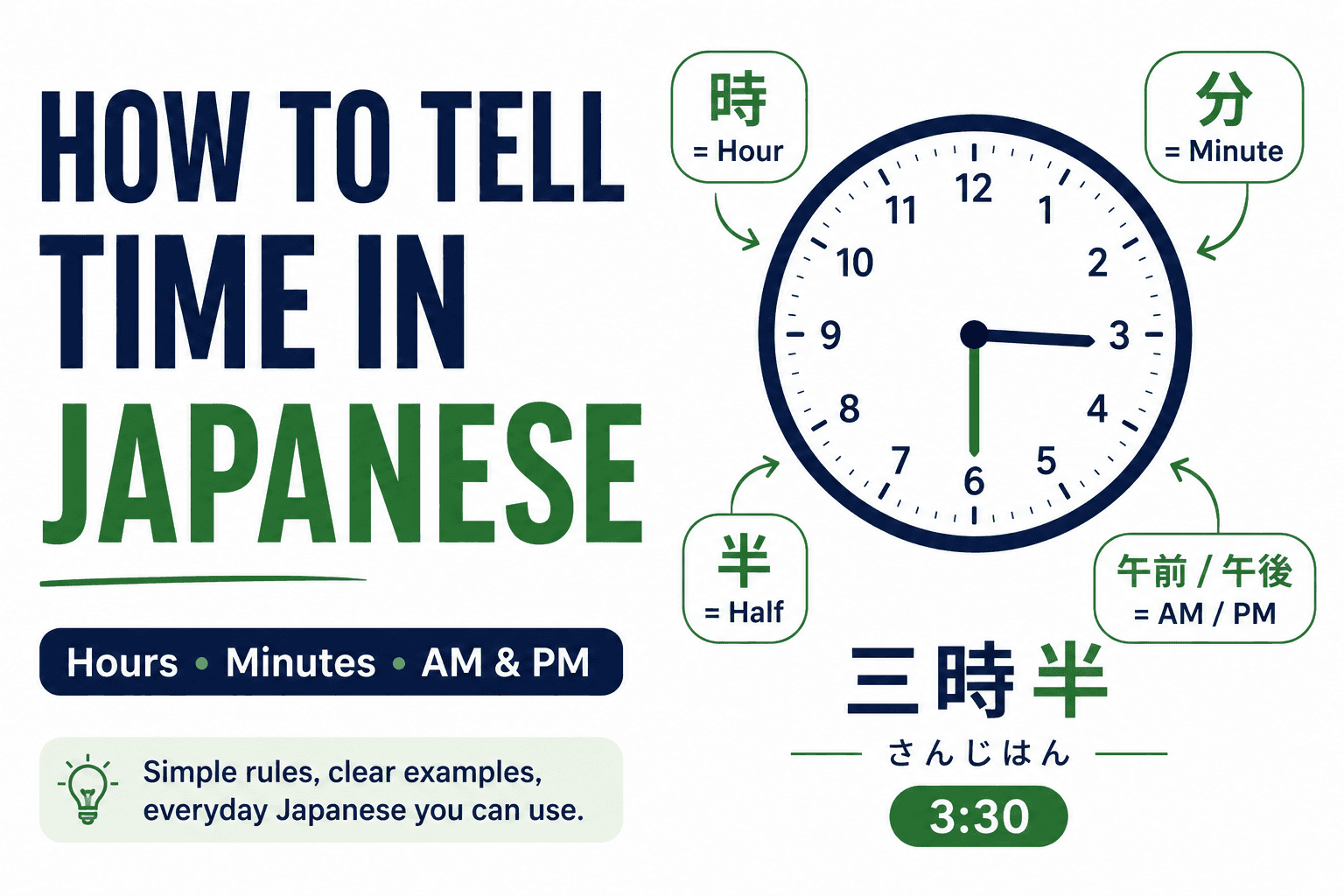
Being able to tell the time is one of the most practical Japanese skills you can learn.
You'll hear it when arranging to meet friends, checking train schedules, making restaurant reservations and talking about your daily routine.
At first, Japanese time expressions might seem complicated.
Why does 3 minutes end with ぷん, while 5 minutes ends with ふん?
Why is 4 o'clock pronounced よじ instead of よんじ?
The good news is that most of the system is surprisingly logical.
If you've already learned Japanese numbers from 1 to 100, you're more than halfway there.
In this guide, you'll learn:
How to tell the time in Japanese
How to say hours and minutes
How to ask "What time is it?"
How to say AM and PM
Common pronunciation changes
Beginner mistakes to avoid
By the end of this guide, you'll be able to read and say everyday times with confidence.
TLDR
Japanese time is built using numbers together with 時 (じ) for hours and 分 (ふん / ぷん) for minutes. Once you know the basic pronunciation changes, telling the time becomes much easier than it first appears.
Quick Answer
Japanese time follows a simple structure:
Hour + 時 (じ) + Minute + 分 (ふん / ぷん)
For example:
3:00 → 三時 (さんじ)
7:30 → 七時三十分 (しちじ さんじゅっぷん)
9:15 → 九時十五分 (くじ じゅうごふん)
The main challenge isn't the numbers. It's learning a few special pronunciations.
How Time Works in Japanese
Japanese tells time using two important kanji:
時 (じ) = hour
分 (ふん / ぷん) = minute
The basic formula is:
Hour + 時 + Minute + 分
For example:
五時十分
ごじ じゅっぷん
5:10
Once you understand this structure, reading most times becomes straightforward.
How to Say the Hours
Let's start with the hours.
Most of them simply follow this pattern:
Number + 時
Here's a quick reference.
Time | Japanese | Reading |
|---|---|---|
1:00 | 一時 | いちじ |
2:00 | 二時 | にじ |
3:00 | 三時 | さんじ |
4:00 | 四時 | よじ |
5:00 | 五時 | ごじ |
6:00 | 六時 | ろくじ |
7:00 | 七時 | しちじ |
8:00 | 八時 | はちじ |
9:00 | 九時 | くじ |
10:00 | 十時 | じゅうじ |
11:00 | 十一時 | じゅういちじ |
12:00 | 十二時 | じゅうにじ |
You might notice a few readings don't follow the pattern perfectly.
For example:
4 o'clock is よじ, not よんじ
7 o'clock is usually しちじ, not ななじ
9 o'clock is くじ, not きゅうじ
These are standard pronunciations, so they're worth memorising early.
Fortunately, there are only a few exceptions.
How to Say the Minutes
Minutes are where beginners usually get confused.
That's because 分 can be pronounced as either:
ふん
ぷん
The pronunciation changes depending on the number.
Here are the most common examples.
Minutes | Japanese | Reading |
|---|---|---|
1 | 一分 | いっぷん |
2 | 二分 | にふん |
3 | 三分 | さんぷん |
4 | 四分 | よんぷん |
5 | 五分 | ごふん |
6 | 六分 | ろっぷん |
7 | 七分 | ななふん |
8 | 八分 | はっぷん |
9 | 九分 | きゅうふん |
10 | 十分 | じゅっぷん |
It looks like a lot at first.
In reality, you'll quickly begin recognising the rhythm after seeing these pronunciations a few times.
Don't worry about memorising every variation on your first day.
Focus on using them in real examples instead.
Putting Hours and Minutes Together
Once you know the hours and minutes, you simply combine them.
For example:
三時十五分
さんじ じゅうごふん
3:15
八時二十分
はちじ にじゅっぷん
8:20
九時四十五分
くじ よんじゅうごふん
9:45
You'll notice the structure stays exactly the same.
That's what makes Japanese time much easier than it first appears.
How to Ask the Time
Once you know how to read the clock, the next step is asking someone what time it is.
The most common question is:
今、何時ですか。
Ima, nanji desu ka?
What time is it now?
A typical reply might be:
三時です。
Sanji desu.
It's three o'clock.
Or, if you want to be more specific:
三時二十分です。
Sanji nijuppun desu.
It's 3:20.
This simple question and answer pattern is one you'll hear frequently in everyday conversations.
How to Say AM and PM
Japanese also has words for AM and PM.
English | Japanese | Reading |
|---|---|---|
AM | 午前 | ごぜん (gozen) |
PM | 午後 | ごご (gogo) |
These are placed before the time.
For example:
午前九時
Gozen kuji
9:00 AM
午後七時三十分
Gogo shichiji sanjuppun
7:30 PM
In casual conversations, people often leave out 午前 or 午後 when the meaning is already obvious from the context.
Talking About Daily Routines
Telling the time becomes much more useful when you can describe your daily schedule.
Here are a few examples.
七時に起きます。
Shichiji ni okimasu.
I wake up at 7 o'clock.
八時半に学校へ行きます。
Hachiji han ni gakkō e ikimasu.
I go to school at 8:30.
午後六時に仕事が終わります。
Gogo rokuji ni shigoto ga owarimasu.
Work finishes at 6:00 PM.
Notice the particle に.
It's commonly used when referring to a specific time that an action takes place.
What Does 半 Mean?
You'll often hear Japanese people say:
半 (はん)
This means:
half
Instead of saying:
三時三十分
people often simply say:
三時半
Sanji han
3:30
Similarly:
六時半 = 6:30
八時半 = 8:30
十時半 = 10:30
Using 半 sounds more natural in everyday conversation and is worth learning early.
Common Beginner Mistakes
Forgetting the Special Hour Readings
Most hours are straightforward, but a few have unique pronunciations.
Remember these:
4:00 = よじ
7:00 = しちじ
9:00 = くじ
These three are responsible for most beginner mistakes.
Mixing Up ふん and ぷん
The pronunciation of 分 changes depending on the number.
Don't worry if you can't remember every rule immediately.
With enough listening practice, the correct pronunciation gradually becomes automatic.
It's much more important to understand the pattern than to memorise every exception on your first attempt.
Forgetting に
When talking about a specific time that something happens, remember to include the particle に.
For example:
✅ 七時に起きます。
I wake up at seven.
Without に, the sentence sounds incomplete in most situations.
How to Practise Telling Time
One of the easiest ways to improve is to use your own daily routine.
Whenever you check the clock, try saying the time in Japanese.
For example:
"It's 8:15."
"The meeting starts at 2:30."
"Dinner is at 7 o'clock."
You can also change your phone's language to Japanese and practise reading the time whenever you unlock your screen.
These small moments of practice quickly build confidence because you're using the language in real life.
Final Thoughts
Telling the time in Japanese may seem intimidating at first, but it's built on a very logical system.
Once you've learned 時, 分, and a few pronunciation changes, you'll already be able to understand and say most everyday times.
Rather than trying to memorise every possible combination, focus on recognising the patterns.
The more often you use Japanese to talk about your own schedule, the more natural these expressions will become.
What Should You Learn Next?
Now that you know how to tell the time, here are a few related guides to continue building your Japanese vocabulary.
Strengthen the number patterns that make telling time much easier.
📖 Days of the Week in Japanese
Learn how to combine times with weekdays when making plans.
Master the months so you can talk about dates naturally.
📖 This Week, Next Week & Week After Next in Japanese
Learn useful time expressions for discussing your schedule and future plans.
Continue Your Japanese Journey
Understanding time is another important step towards using Japanese in everyday life.
By learning practical topics like numbers, dates and schedules, you'll build vocabulary that you can use immediately.
Japanese Journey helps you learn the same way, through guided vocabulary paths, native audio and daily review that gradually build your confidence one lesson at a time.
Keep practising consistently, and before long you'll be thinking about time in Japanese without even realising it.
Practice more at 👉 www.japanesejourney.app
Or visit our YouTube channel for free practice videos: www.youtube.com/japanesejourneylearn