
How Do You Know You’re Ready for JLPT N3?
TLDR
You’re probably ready for JLPT N3 when:
N4 material feels comfortable
you can read N3 passages without translating every sentence
you can keep going when you meet unknown vocabulary
near-natural-speed listening feels manageable
you can finish practice sections within the time limit
no single section is consistently collapsing
you can reproduce that performance across multiple timed practice tests
The biggest mistake is thinking:
“I finished N3 material, so I must be ready.”
A better model is:
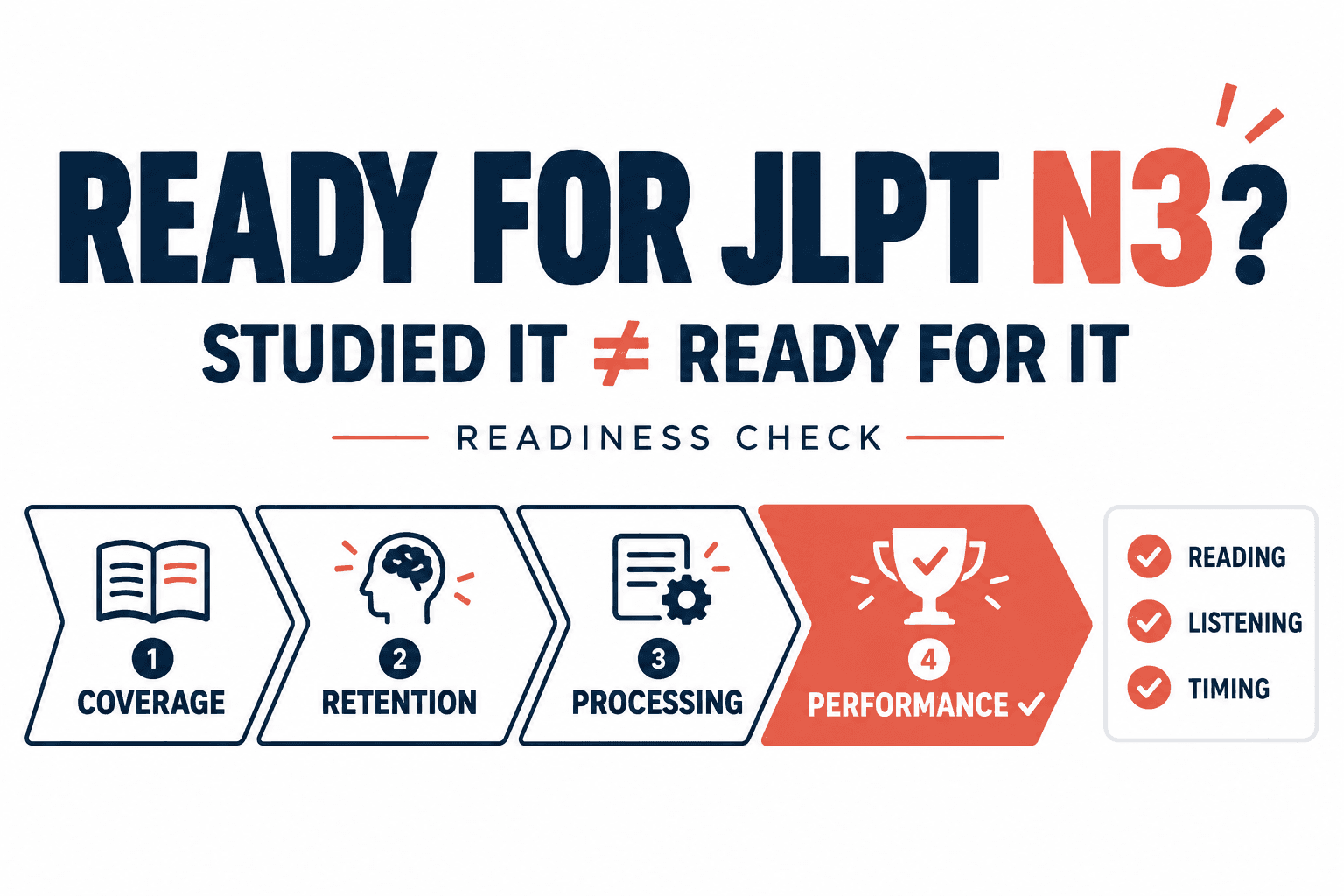
Coverage → Retention → Processing → Performance
You are not ready because you have studied N3.
You are ready when you can process N3-level Japanese reliably, in context, under time pressure.
Quick Answer
You’re likely ready for JLPT N3 when N4 feels easy, N3 reading is understandable without constant translation, everyday listening at near-natural speed is manageable, and your timed practice performance is consistently balanced across Language Knowledge, Reading, and Listening.
The key word is:
consistently
One lucky practice test is not enough.
Neither is knowing a certain number of vocabulary words.
N3 readiness is about whether your Japanese still works when:
the passage gets longer
the audio keeps moving
the clock is running
you miss a word
you get tired
What Does “Ready for N3” Actually Mean?
There are several ways learners define “ready.”
Some mean:
I finished an N3 textbook.
Others mean:
I learned 3,500 words.
Or:
I know around 650 kanji.
Or:
I have studied for a year.
Those can all be useful indicators.
But none of them proves that you are ready for the exam.
JLPT N3 tests whether you can understand Japanese used in everyday situations to a certain degree.
That includes:
language knowledge
reading
listening
And the exam puts all of that under time pressure.
So readiness should mean:
I can access what I know quickly enough to use it during the test.
That is a very different standard from:
I have seen this before.
The Four Stages: Coverage → Retention → Processing → Performance
A useful way to think about N3 readiness is in four stages.
Stage 1: Coverage
You have studied the material.
For example:
vocabulary
kanji
grammar
You can say:
“I’ve covered most N3 grammar.”
That is progress.
But coverage alone is not enough.
Stage 2: Retention
You can still recognise the material later.
A word you learned yesterday is easy.
What about:
three weeks later?
Can you still recognise it?
Can you retrieve its meaning?
Can you understand it in a different sentence?
That is retention.
Stage 3: Processing
You can recognise the material quickly enough in real context.
For example:
You see a word in a passage and understand it immediately.
You hear a grammar pattern and do not need to pause mentally.
You follow the meaning while new Japanese is still arriving.
That is processing.
Stage 4: Performance
You can do all of that:
reliably under exam conditions.
You can:
stay accurate
keep pace
manage fatigue
recover after a difficult question
finish on time
This is the final step.
So:
Coverage = I studied it
Retention = I still know it
Processing = I understand it quickly
Performance = I can do it reliably under test conditions
N3 readiness lives in the last two stages.
Sign #1: N4 Feels Easy
One of the strongest signs that you are ready to move toward N3 is:
N4 material no longer feels like your limit.
You should increasingly be able to:
recognise common N4 vocabulary quickly
read N4 passages without constant lookup
understand core grammar automatically
follow N4 listening without fighting every sentence
A useful rule is:
Your previous level should increasingly feel like your warm-up.
If N4 still feels extremely difficult, N3 may be too early.
Passing N4 and being comfortable with N4 are not exactly the same thing.
You may have passed.
But if every N4 passage still feels exhausting, there is probably more foundation to strengthen.
Sign #2: You Can Read Without Knowing Every Word
This is one of the most important N3 skills.
At lower levels, learners often feel:
“If I don’t know one word, I can’t understand the sentence.”
At N3, you need more tolerance for missing information.
Suppose you read a paragraph and encounter one unfamiliar word.
Can you:
infer the rough meaning?
skip it temporarily?
keep reading?
still understand the main point?
If yes, that is a very good sign.
If one unknown word causes the entire passage to collapse, you may still be relying too much on complete word-by-word understanding.
N3 Does Not Require Perfect Vocabulary
You do not need to know every single word.
In fact, one of the skills N3 begins to demand is:
continuing despite uncertainty.
That is closer to how real reading works too.
You rarely understand every word in every text, even in a language you know well.
The important question is:
Can you still follow the meaning?
Sign #3: You Understand the Whole Passage
Another important shift happens between:
understanding sentences
and:
understanding a text.
Imagine you can translate every sentence individually.
That sounds good.
But then someone asks:
What was the writer’s main point?
and you are not sure.
That is a warning sign.
At N3, you increasingly need to understand:
why one sentence follows another
cause and effect
contrast
the writer’s main point
which information matters
what a pronoun or phrase refers to
how the passage develops
Connectors Should Start Helping You
Words such as:
しかし
however
そのため
therefore / because of that
つまり
in other words
一方
on the other hand
それで
and so
ところが
however / but unexpectedly
should increasingly act like signposts.
You do not just translate them.
You use them to predict:
what kind of idea comes next.
That is a strong reading-readiness signal.
Sign #4: Near-Natural Listening Feels Manageable
N3 listening is a meaningful jump from N4.
At N4, everyday conversations are generally slower.
At N3, you are expected to follow coherent everyday conversations spoken at near-natural speed.
That does not mean:
you understand every word instantly.
It means you can usually keep track of:
who is speaking
what the situation is
what someone wants
what changed
what they decided
what happens next
Ask Yourself This
After listening to an N3-style dialogue:
Can you explain:
“They were discussing X, there was a problem with Y, and they decided to do Z.”
If yes, that is much more important than:
“I recognised 70% of the words.”
Listening is about maintaining the thread.
Missing One Phrase Should Not End the Conversation
A strong readiness sign is:
you miss something, but recover.
A weak readiness sign is:
you miss one phrase and mentally replay it while the next 20 seconds of audio disappear.
That recovery skill matters enormously.
Sign #5: You Can Finish Reading in Time
You may understand N3 reading eventually.
That does not automatically mean you are exam-ready.
The current N3 structure gives you:
30 minutes for Vocabulary
70 minutes for Grammar + Reading
40 minutes for Listening
The Grammar + Reading section is where pacing becomes especially important.
If you can solve an N3 passage correctly in:
20 minutes
but the exam realistically allows you:
8 minutes
then you still have a readiness gap.
The Important Distinction
Understanding eventually ≠ understanding in time
Timed comprehension is its own skill.
You need to learn when to:
move on
stop rereading
avoid overanalysing
trust context
return later if needed
If you routinely leave entire passages unfinished, your Japanese may be close to N3, but your exam performance is not ready yet.
Sign #6: No Section Is Collapsing
N3 is scored across three sections:
Language Knowledge
Reading
Listening
To pass, you need:
95 / 180 overall
and at least:
19 / 60 in Language Knowledge
19 / 60 in Reading
19 / 60 in Listening
That means one strong section cannot completely rescue a collapsing section.
For example:
Learner A
Vocabulary/Grammar: strong
Reading: solid
Listening: solid
This is healthy.
Learner B
Vocabulary/Grammar: excellent
Reading: weak
Listening: extremely weak
That learner may know a lot of Japanese.
But the exam structure makes the imbalance dangerous.
A useful rule is:
You are not ready if your entire strategy depends on one strong section rescuing another.
Sign #7: You Can Handle a Full N3 Test
Short practice sessions are useful.
But eventually you need to experience the full test.
N3 lasts around:
140 minutes
across the three test sections.
That creates fatigue.
You may be able to:
read well for 20 minutes
listen well when fresh
answer vocabulary quickly
But can you still listen carefully after a long grammar and reading section?
That is part of readiness too.
Full-Test Practice Reveals Different Problems
A complete timed practice test may show:
you rush vocabulary
reading takes too long
concentration drops
listening accuracy falls when tired
you panic after a difficult section
You will not discover all of that from isolated exercises.
That is why full practice matters.
How Should You Use N3 Mock Tests?
Not all practice material serves the same purpose.
Official Sample Questions
The official JLPT sample questions are useful for understanding:
question formats
difficulty
item types
Use them when you first want to ask:
What does N3 actually look like?
But individual sample questions are not enough to diagnose full readiness.
Official Practice Workbooks
The official JLPT practice workbooks are much more useful for deeper assessment.
They contain nearly the same number of questions as an actual test.
Use them to check:
pacing
endurance
section balance
recurring mistakes
A good progression is:
Early
Sample individual question types.
Middle
Do timed sections.
Later
Complete full practice tests under realistic conditions.
What Mock Score Means You’re Ready?
This is tricky.
JLPT official results use scaled scores.
That means you should not assume:
60% correct = exactly 108/180
or:
every question is worth the same number of points.
So there is no official raw-percentage number that guarantees:
“You are ready.”
Instead, use practice tests diagnostically.
Green Zone
You are probably in a good position if:
you finish within the time limit
your performance is comfortably above borderline
no section repeatedly collapses
you perform similarly across multiple practice tests
N3 feels challenging rather than chaotic
That suggests:
N3 is a reasonable exam target.
Yellow Zone
You may be close if:
you understand most material
you sometimes run out of time
one section is noticeably weaker
practice performance swings widely
you need a little too much translation
That suggests:
identify the bottleneck and target it.
Red Zone
You probably need more foundation if:
large parts of the test remain unfinished
reading is mostly guessing
listening feels like an uninterrupted stream
N4 material still feels difficult
you depend heavily on dictionaries or translation
That does not mean:
“You are bad at Japanese.”
It means:
the target is still ahead of your current processing level.
10-Question N3 Readiness Check
Use this as a quick self-assessment.
This is a Japanese Journey framework, not an official JLPT scoring system.
Answer yes or no.
1. Does N4 reading feel comfortable?
Not perfect.
Comfortable.
2. Can you read N3 passages without translating every sentence?
3. Can you keep reading when you meet unknown vocabulary?
4. Can you identify the main point of a passage?
5. Can you finish N3-style reading within a reasonable time limit?
6. Can you follow everyday conversations at near-natural speed?
7. Can you explain what speakers decided or intended?
8. Are your Language Knowledge, Reading, and Listening reasonably balanced?
9. Have you completed a full timed N3 practice test?
10. Can you reproduce your performance across more than one test?
Your Result
8–10 Yes
N3 is likely a reasonable exam target.
Your next priority should be:
exam performance and weak-area refinement.
5–7 Yes
You are probably close.
Find the area that is limiting you most.
0–4 Yes
Focus more on the N4→N3 transition first.
You will benefit more from strengthening the foundation than repeatedly testing yourself.
Again:
this is not an official JLPT readiness score.
It is a practical diagnostic.
Vocabulary and Kanji: How Much Is Enough?
A common planning estimate for N3 is around:
3,500–3,750 cumulative vocabulary words
around 650 kanji
These are practical study estimates.
They are not official JLPT requirements.
And they should not become:
“I cannot take N3 until my flashcard app says 3,750.”
Vocabulary and kanji matter enormously.
But they are ingredients.
Readiness is whether you can use those ingredients while:
reading
listening
solving questions
working under time pressure
A Better Vocabulary Readiness Question
Instead of:
How many words do I know?
ask:
How quickly do I recognise the words I know?
If you technically know 3,500 words but every passage requires constant pauses, recognition speed is still limiting you.
Ready to Pass vs Comfortably N3
There is another important distinction.
Ready to Pass N3
You are capable of clearing:
95 / 180
plus every sectional minimum.
Comfortably N3
N3-level material feels increasingly stable.
You can:
read without constant struggle
follow everyday listening
recognise core grammar quickly
understand the main idea even with gaps
Those are not exactly the same standard.
Someone can narrowly pass N3 without feeling comfortably intermediate.
That is normal.
CEFR Reference at N3
Since December 2025, successful N3 results also include a CEFR reference indication for the skills measured by the JLPT.
For N3:
95–103 → A2
104+ → B1
But remember:
this applies only to the linguistic knowledge, reading, and listening competencies measured by the JLPT.
It does not assess every language skill.
Does Passing N3 Mean You Can Speak Japanese?
No.
The JLPT does not directly test:
speaking
writing
interactive conversation
So:
being ready for JLPT N3 is not the same as being equally strong at every Japanese skill.
You could be very good at:
reading
vocabulary
listening
and still feel hesitant in conversation.
Or you could speak comfortably but struggle with kanji-heavy reading.
The JLPT measures a specific set of abilities.
That makes it useful.
But it does not measure everything.
What If You’re Almost Ready?
If you are in the yellow zone, do not restart your entire N3 plan.
Find the bottleneck.
If Reading Is Weak
Focus on:
timed reading
passage structure
connectors
reading without a dictionary
summarising the main point
Measure:
how long passages take.
If Listening Is Weak
Increase:
connected everyday listening
near-natural-speed material
one-pass comprehension
predicting what comes next
identifying speaker intention
Do not only replay the same sentence ten times.
You need some practice where:
the audio keeps moving.
If Vocabulary and Grammar Are Weak
Use targeted review.
Focus on:
frequent mistakes
weak vocabulary
confusing grammar pairs
retrieval in sentences
Do not automatically restart every textbook chapter.
Fix the actual gaps.
If Timing Is Weak
Practise under a clock.
Gradually reduce:
rereading
overanalysis
time spent on one difficult question
Sometimes the missing skill is not Japanese knowledge.
It is exam execution.
Should You Register If You’re Not Completely Ready?
You do not need to feel:
100% ready
before registering.
In fact, very few learners ever feel completely ready.
If the exam is still several months away and:
N4 is comfortable
N3 is challenging but understandable
you know your weaknesses
you have enough time to work on them
then registering can create a useful deadline.
But if N3 currently feels:
mostly incomprehensible
then registration itself will not solve the gap.
Use the exam as a target.
Not as a substitute for preparation.
Common Mistake 1: Using Vocabulary Count as the Readiness Test
Knowing 3,500 words is useful.
But the exam does not ask:
“How many flashcards have you completed?”
It asks you to use Japanese inside:
grammar
reading
listening
Common Mistake 2: Finishing a Textbook and Assuming You’re Ready
Finishing a book means:
you covered the material.
Remember the four stages:
Coverage → Retention → Processing → Performance
A completed textbook is mostly evidence of:
coverage.
You still need the other stages.
Common Mistake 3: Only Doing Untimed Practice
Untimed practice helps you learn.
But eventually:
the clock matters.
If your only successful practice happens with unlimited time, you do not yet know whether your knowledge is exam-ready.
Common Mistake 4: Ignoring One Weak Section
N3 has sectional minimums.
Do not say:
“My vocabulary is excellent, so weak listening is okay.”
It may not be.
Every section needs to survive.
Common Mistake 5: Trying to Understand Every Word
If you stop at every unfamiliar word, N3 reading becomes too slow.
Learn to distinguish:
important unknown word
from:
word I can safely skip.
That is a real reading skill.
Common Mistake 6: Trusting One Lucky Mock
You pass one practice test.
Great.
Now:
can you do it again?
Readiness is about consistency.
One unusually easy test or one lucky guessing streak should not define your level.
Common Mistake 7: Waiting Until You Feel Completely Ready
You may never feel completely ready.
A better question is:
Is my performance reliable enough that N3 is a sensible target?
That is a much more useful standard.
Frequently Asked Questions
How do you know if you’re ready for JLPT N3?
You are likely ready when N4 feels comfortable, you can understand N3 passages without translating every sentence, follow everyday conversations at near-natural speed, finish practice sections within the time limit, and perform consistently across Language Knowledge, Reading, and Listening.
What score do you need to pass JLPT N3?
You need:
at least 95/180 overall
at least 19/60 in Language Knowledge
at least 19/60 in Reading
at least 19/60 in Listening
You must meet both the overall score and every sectional minimum.
How should I test whether I’m ready for N3?
Use a combination of:
official sample questions
timed section practice
full official-style practice tests
Full timed practice is especially useful because it reveals:
pacing
fatigue
weak sections
consistency
What mock score means I’m ready for N3?
There is no official raw-percentage score that guarantees readiness because the JLPT uses scaled scoring.
Instead, look for:
finishing on time
comfortably competitive performance
no collapsing section
consistent results across multiple tests
Do I need to know every N3 word?
No.
You need enough vocabulary to understand the material, but N3 also requires the ability to continue reading when some vocabulary is unfamiliar.
How many words do I need for N3?
A common practical planning estimate is around:
3,500–3,750 cumulative words
But this is not an official JLPT requirement.
How many kanji do I need for N3?
A common planning estimate is around:
650 kanji
Again, this is not an official fixed list.
Is N3 much harder than N4?
Yes.
A useful mental model is:
N4 = decode basic Japanese
N3 = process everyday Japanese
N3 requires more vocabulary and grammar, but also faster reading, stronger listening, and better ability to follow connected meaning.
Does passing N3 mean you are conversational?
Not necessarily.
The JLPT does not directly test speaking, writing, or interactive conversation.
N3 measures language knowledge, reading, and listening.
Should I take N3 if I’m not sure I’ll pass?
If N3 is challenging but understandable and you have enough preparation time, registering can give you a useful goal.
If most N3 material is still incomprehensible, build more foundation first.
What Should You Learn Next?
If N3 is your target, these guides will help you close the remaining gaps.
JLPT N4 vs N3: How Big Is the Jump?
Understand exactly what changes as you move from basic Japanese into N3.
How Long Does It Take to Go from JLPT N4 to N3?
Use this to plan a realistic transition timeline.
JLPT N4 Study Plan
Use this if N4 material still does not feel automatic.
JLPT N3 Vocabulary List
Build the vocabulary you increasingly need for N3 reading and listening.
How Many Words Do You Need for JLPT N3?
Understand the practical vocabulary target without treating it as a rigid requirement.
JLPT N3 Study Plan
Use the full roadmap to structure your N3 preparation.
Continue Your Japanese Journey
It is tempting to measure N3 readiness through things that are easy to count.
vocabulary learned
kanji memorised
grammar lessons completed
months studied
Those numbers are useful.
But they are not the final test.
The progression looks more like this:
Coverage
Have I studied it?
↓
Retention
Do I still know it?
↓
Processing
Can I understand it quickly in context?
↓
Performance
Can I do that reliably under time pressure?
That final step is what turns:
“I studied N3”
into:
“I’m ready to take N3.”
So do not ask only:
How much material have I finished?
Ask:
Can I keep reading when I miss a word?
Can I follow the listening when I miss a phrase?
Can I understand the point of the passage?
Can I finish in time?
Can I do it again tomorrow?
That is what readiness looks like.
Japanese Journey is built around the same idea: progress is not simply what you have seen. It is what you can reliably understand, remember, and use when you need it.